
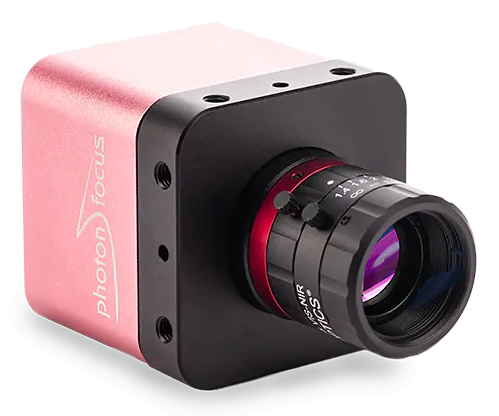
Photonfocus SNAPSHOT RedNIR
Want to test hyperspectral scanning and analysis in the RedNIR range? With this user-friendly real-time GigE camera from Photonfocus, integrating imec?s hyperspectral sensor, you?ll be looking at relevant test data within a few minutes of the installation.
Photonfocus SNAPSHOT RedNIR
VNIR Compare
Photonfocus SNAPSHOT RedNIR
spectral range = 600-870 nm
spectral resolution = 15 bands
spatial resolution = 2040 x 1080
imager type = CMOS imager, CMOSIS CMV2000-based
acquisition speed = Up to 42 hyperspectral cubes/second (limit of GigE vision interface)
pixel pitch = 5.5 ?m pixels, 2/3?? sensor optical format
bit depth = 10 bits
optics = 16/25/35/50 mm lenses, C-mount
camera interface = GigE vision + GPIO for triggering
power consumption <5.1 W
camera dimensions (W x H x D) = 55 x 55 x 52 mm
camera weight = 265 g without optics
software = HSI MOSAIC software for raw image acquisition, data pre-processing, hypercube visualization and classification, including API
2 responses to “Photonfocus SNAPSHOT RedNIR”
Leave a Reply

Quick Comparison
| Photonfocus SNAPSHOT RedNIR remove | Resonon Pika XC2 remove | Specim Fenix remove | Resonon Pika IR-L remove | Specim FX10 remove | HySpex Mjolnir S-620 remove | |
|---|---|---|---|---|---|---|
| Name | Photonfocus SNAPSHOT RedNIR remove | Resonon Pika XC2 remove | Specim Fenix remove | Resonon Pika IR-L remove | Specim FX10 remove | HySpex Mjolnir S-620 remove |
| Image |  |  |  |  |  |  |
| Rating | ||||||
| Content | Photonfocus SNAPSHOT RedNIR Want to test hyperspectral scanning and analysis in the RedNIR range? With this user-friendly real-time GigE camera from Photonfocus, integrating imec?s hyperspectral sensor, you?ll be looking at relevant test data within a few minutes of the installation. | Pika XC2 400 - 1000 nm High-Precision VNIR The Pika XC2 is a high-resolution hyperspectral camera that covers the Visible + Near-Infrared (VNIR) spectral range. The Pika XC2 has high spatial resolution, best in-class spectral resolution, and excellent imaging quality. Popular in VNIR laboratory applications. The Pika XC2 can be used in our laboratory, and outdoor, and airborne hyperspectral systems, as well as standalone or integrated into your system. | Fenix FENIX is optimized for the most demanding geological, law enforcement, and environmental applications. In a single continuous image, FENIX spectral camera delivers the best hyperspectral data ever seen over VNIR, NIR, and SWIR wavelengths. FENIX offers extreme ruggedness and 75% reduction in size and weight compared to previous multi-sensor systems. The excellence in technical performance and physical size has been achieved through innovative and unique ?single optics dual spectrograph? design. | Pika IR-L 925 - 1700 nm Lightweight Infrared The Pika IR-L is a lightweight and compact Near-Infrared (925-1,700 nm) imager. The small size and mass make it well suited for airborne applications, where it can provide invisible to the naked-eye contrast of outdoor features. For a compact, lightweight Visible light spectral range option, please see the Pika L. For a higher spectral and spatial resolution version of the Pika IR-L, please see the Pika IR-L+ imager. | Specim FX10 Specim FX10 is a line-scan hyperspectral camera that operates in the visible and near-infrared (VNIR) region. It is an excellent tool for industrial and scientific applications. The Specim FX10 operates in the 400-1000 nm region, and the color-optimized Specim FX10c in the 400-780 nm region. | HySpex Mjolnir S-620 The HySpex Mjolnir S-620 hyperspectral imaging system for UAVs is the SWIR version of the Mjolnir camera series. Similar to the VNIR version, it provides a unique combination of small form factor and low mass, combined with high-performance specifications and scientific grade data quality. With a weight of less than 4.5 kg and less than 50 W power consumption, HySpex Mjolnir S-620 is very well suited for a wide range of UAVs. NEO offers high-performance unmanned aerial vehicles, fully integrated with the HySpex Mjolnir S-620. The UAV is fitted with a standard battery package allowing up to 30 minutes of flight time. All HySpex Mjolnir systems can also be mounted on a tripod and rotation stage for ground use. |
| Description | spectral range = 600-870 nm spectral resolution = 15 bands spatial resolution = 2040 x 1080 imager type = CMOS imager, CMOSIS CMV2000-based acquisition speed = Up to 42 hyperspectral cubes/second (limit of GigE vision interface) pixel pitch = 5.5 ?m pixels, 2/3?? sensor optical format bit depth = 10 bits optics = 16/25/35/50 mm lenses, C-mount camera interface = GigE vision + GPIO for triggering power consumption <5.1 W camera dimensions (W x H x D) = 55 x 55 x 52 mm camera weight = 265 g without optics software = HSI MOSAIC software for raw image acquisition, data pre-processing, hypercube visualization and classification, including API | Spectral Range (nm) = 400 - 1000 Spectral Channels = 447 Spectral Bandwidth (nm) = 1.3 Spectral Resolution - FWHM (nm) = 1.9 Spatial Pixels = 1600 Max Frame Rate (fps) = 165 f/# = 2.4 Interface = USB 3.0 Dimensions (mm) = 265 x 106 x 75 Weight, w/o lens (kg) = 2.51 | Spectral Range (nm) = 925 - 1700 Spectral Channels = 236 Spectral Bandwidth (nm) = 3.3 Spectral Resolution - FWHM (nm) = 5.9 Spatial Pixels = 320 Max Frame Rate (fps) = 364 f/# = 1.8 Interface = GigE Dimensions (mm) = 210 x 68 x 63 Weight, w/o lens (kg) = 1.01 | Spectral Range = 400-1000 / 400-780 (c-version) Spectral resolution (FWHM) = 5.5 nm (mean) Spectral sampling/pixel = 2.7 nm, With default binning Spectral bands = 224 / 140 (c-version), With default binning Numerical aperture = 1.7, With default lens Optics magnification = 0.80 Effective pixel size = 19.9x9.97 ?m, At fore lens image plane Effective slit width = 42 ?m, At fore lens image plane Effective slit length = 10.2 mm, At fore lens image plane SNR @ max. signal = 420 : 1 Spatial samples = 1024 Bit depth = 12 Maximum frame rate = 327 FPS full range / 514 FPS full range (c-version) Binning = 2,4,8 spectral and spatial Default: 2 spectral x 1 spatial ROI = Freely selectable multiple bands of interest. Minimum height of ROI is two 1-binned rows. Maximum frame rate is determined by the total number of rows included in the mMROI?s Pixel operability = 99.993% Image corrections = Non uniformity correction/Bad pixel replacement/Automatic Image Enhancement (AIE)/One point NUC. AIE: Unified spectral calibration + corrected smile and keystone aberrations Sensor material = CMOS Sensor cooling = Passive Full well capacity = 90 ke- Read-out modes = IWR / ITR Optics temperature = Passive Lens mount = Custom mount Fore lens FOV options = 12 deg/ 38 deg (default)/ 47 deg/ 51 deg/ 83 deg. Only the default lens is specifically designed for FX10. With other lens options, optical parameters may vary. Camera digital data output/control interface = GigE Vision, CameraLink Camera control protocols = GenICam, ASCII Power input = 12 V DC (+-10%) Power consumption = Max 4 W Connectors = Industrial Ethernet OR CameraLink 26-pin, 0.5? MDR IP = IP52 Dimensions (L x W x H) = 150 x 85 x 71 mm Mounting surface option on three sides. Mounting kit adds 24 mm distance on mounting side. Weight = 1.3 kg Storage temperature = -20 ... +50?C (non-condensing) Operating temperature = +5 ? +40?C (non-condensing) Relative humidity = 5% - 95% (non-condensing) | Spectral range = 970 - 2500 nm Spatial pixels = 620 Spectral channels and sampling = 300 bands @ 5.1 nm F-number = F1.9 FOV = 20? Pixel FOV across/along = 0.54/0.54 mrad Bit resolution = 16 bit Noise floor = 80 e- Dynamic range = 10000 Peak SNR (at full resolution) > 900 Max speed (at full resolution) = 170 fps Power consumption* = 50 W Dimensions (l-w-h)* = 254 - 175 - 170 mm Weight* < 4.5 kg *Includes IMU/GPS and DAU - <5 kg including standard battery |


I have realized that in cameras, extraordinary receptors help to focus automatically. The sensors associated with some digital cameras change in contrast, while others employ a beam with infra-red (IR) light, especially in low light. Higher specification cameras from time to time use a combination of both systems and likely have Face Priority AF where the video camera can ‘See’ a face while focusing only on that. Many thanks for sharing your ideas on this blog site.
I’m curious to find out what blog platform you happen to be working with? I’m having some small security problems with my latest blog and I’d like to find something more secure. Do you have any solutions?