
Photonfocus SNAPSHOT RedNIR
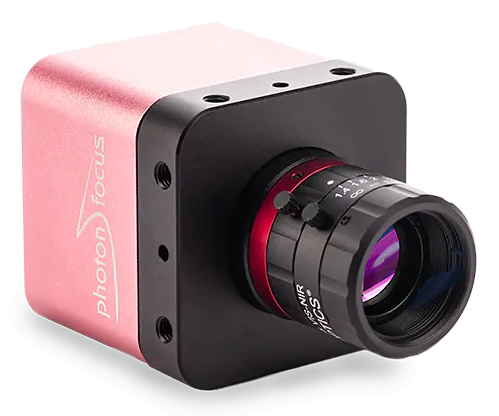
Want to test hyperspectral scanning and analysis in the RedNIR range? With this user-friendly real-time GigE camera from Photonfocus, integrating imec?s hyperspectral sensor, you?ll be looking at relevant test data within a few minutes of the installation.
Photonfocus SNAPSHOT RedNIR
VNIR Compare
Photonfocus SNAPSHOT RedNIR
spectral range = 600-870 nm
spectral resolution = 15 bands
spatial resolution = 2040 x 1080
imager type = CMOS imager, CMOSIS CMV2000-based
acquisition speed = Up to 42 hyperspectral cubes/second (limit of GigE vision interface)
pixel pitch = 5.5 ?m pixels, 2/3?? sensor optical format
bit depth = 10 bits
optics = 16/25/35/50 mm lenses, C-mount
camera interface = GigE vision + GPIO for triggering
power consumption <5.1 W
camera dimensions (W x H x D) = 55 x 55 x 52 mm
camera weight = 265 g without optics
software = HSI MOSAIC software for raw image acquisition, data pre-processing, hypercube visualization and classification, including API
2 responses to “Photonfocus SNAPSHOT RedNIR”
Leave a Reply

Quick Comparison
| Photonfocus SNAPSHOT RedNIR remove | Resonon Pika IR-L+ remove | Resonon Pika L remove | Specim SWIR remove | HySpex VS-1200 remove | Resonon Pika XC2 remove | |
|---|---|---|---|---|---|---|
| Name | Photonfocus SNAPSHOT RedNIR remove | Resonon Pika IR-L+ remove | Resonon Pika L remove | Specim SWIR remove | HySpex VS-1200 remove | Resonon Pika XC2 remove |
| Image |  |  |  |  |  |  |
| Rating | ||||||
| Content | Photonfocus SNAPSHOT RedNIR Want to test hyperspectral scanning and analysis in the RedNIR range? With this user-friendly real-time GigE camera from Photonfocus, integrating imec?s hyperspectral sensor, you?ll be looking at relevant test data within a few minutes of the installation. | Pika IR-L+ 925 - 1700 nm Lightweight, High-Precision Infrared The Pika IR-L+ imager is a high spatial and spectral resolution Near-Infrared (925-1,700 nm) imager in a lightweight, compact format. It is well suited for field research, yet compatible with all imaging platforms (airborne, benchtop, or outdoor). For a compact, lightweight Visible light spectral range option, please see the Pika L. For higher imaging speeds, please see the Pika IR-L. | Pika L 400 - 1000 nm Lightweight, Compact VNIR The Pika L is a lightweight, compact hyperspectral camera that covers the Visible + Near-Infrared (VNIR) spectral range. It is our most popular imager for remote sensing applications. The Pika L can be used in our airborne, laboratory, and outdoor hyperspectral systems, as well as standalone or integrated into your system. | SWIR SWIR is a high-speed short-wave infrared hyperspectral camera that operates in the 1000-2500 nm range. It has 384 spatial pixels and achieves image rates of up to 400 frames per second using a CameraLink connection. To assure indoor/outdoor usage in varying conditions, it now has rugged weather-proof IP54 casing and temperature-stabilized optics but still uses less power than before, only 50W nominal. Its temperature-stabilized optics provide stability and sensitivity required in the most challenging near-infrared chemical imaging applications, from pharmaceutical quality assurance to food and agriculture analysis. The SWIR camera meets the highest requirements in the lab, industry, and field. | HySpex VS-1200 The HySpex VS-1200 hyperspectral camera is developed for airborne applications requiring extreme resolution in both VNIR and SWIR spectral regions. The HySpex VS-1200 is a novel high-resolution instrument designed for airborne applications at altitudes greater than 400m. The camera produces the highest scientific grade level data, commercially available, having FWHM less than 1.2 pixels spatially and less than 1.5 pixels spectrally. The combined VNIR-SWIR cube has coregistration errors, and smile and keystone of less than 10% of a pixel. With 40 degrees FOV, the camera is ideal for mapping large areas with high accuracy and resolution. The camera is delivered with an integrated high-performance IMU/GPS and data acquisition unit with removable storage bays as a standard. Existing navigation systems can also be integrated/utilized. A standard passive damping solution is included as a part of the default delivery package, but mounting plates for active damping solutions, such as GSM4000 or PAV80 can be supplied. | Pika XC2 400 - 1000 nm High-Precision VNIR The Pika XC2 is a high-resolution hyperspectral camera that covers the Visible + Near-Infrared (VNIR) spectral range. The Pika XC2 has high spatial resolution, best in-class spectral resolution, and excellent imaging quality. Popular in VNIR laboratory applications. The Pika XC2 can be used in our laboratory, and outdoor, and airborne hyperspectral systems, as well as standalone or integrated into your system. |
| Description | spectral range = 600-870 nm spectral resolution = 15 bands spatial resolution = 2040 x 1080 imager type = CMOS imager, CMOSIS CMV2000-based acquisition speed = Up to 42 hyperspectral cubes/second (limit of GigE vision interface) pixel pitch = 5.5 ?m pixels, 2/3?? sensor optical format bit depth = 10 bits optics = 16/25/35/50 mm lenses, C-mount camera interface = GigE vision + GPIO for triggering power consumption <5.1 W camera dimensions (W x H x D) = 55 x 55 x 52 mm camera weight = 265 g without optics software = HSI MOSAIC software for raw image acquisition, data pre-processing, hypercube visualization and classification, including API | Spectral Range (nm) = 925 - 1700 Spectral Channels = 470 Spectral Bandwidth (nm) = 1.7 Spectral Resolution - FWHM (nm) = 3.8 Spatial Pixels = 640 Max Frame Rate (fps) = 176 f/# = 1.8 Interface = GigE Dimensions (mm) = 210 x 68 x 63 Weight, w/o lens (kg) = 1.01 | Spectral Range (nm) = 400 - 1000 Spectral Channels = 281 Spectral Bandwidth (nm) = 2.1 Spectral Resolution - FWHM (nm) = 3.3 Spatial Pixels = 900 Max Frame Rate (fps) = 249 f/# = 2.4 Interface = USB 3.0 Dimensions (mm) = 115 x 104 x 66 Weight, w/o lens (kg) = 0.64 | Spectral range = 1000 - 2500 nm Spectral resolution (FWHM) = 12 nm (30 ?m slit) Spectral sampling / pixel = 5.6 nm F/# = F/2.0 Slit width = 30 ?m (50 or 80 ?m optional) Effective slit length = 9.2 mmRICAL CHARACTERISTICS Sensor = Cryogenically cooled MCT detector Spatial pixels = 384 Spectral bands = 288 Pixel size = 24 x 24 ?m Detector cooling = Stirling, 25 000 h MTTF Signal-to-noise ratio = 1050:1 (at max. signal level) Camera output = 16 bit CameraLink Data cable Length = 5m Camera control = USB/RS232 Frame grabber = NI-1433 Epix grabber = E4* Frame rate = 450 fps (maximum full frame) Exposure time range = 0.1 - 20 ms Power consumption = Nominal < 50 W Input voltage = 18 - 36 VNICAL CHARACTERISTICS Size (L x W x H) = Sensor 545 x 176 x 178 mm, PSU & control unit 300 x 190 x 130 mm Weight = 14 kg & approx. 5 kg Body = Anodized aluminium with mounting screwholes Lens mount = Standard C-mount Shutter = Electro-mechanicalONMENTAL CHARACTERISTICS Storage = -20... +50 ?C Operating = +5... +40 ?C non-condensing | Spectral Range (nm) = 400 - 1000 Spectral Channels = 447 Spectral Bandwidth (nm) = 1.3 Spectral Resolution - FWHM (nm) = 1.9 Spatial Pixels = 1600 Max Frame Rate (fps) = 165 f/# = 2.4 Interface = USB 3.0 Dimensions (mm) = 265 x 106 x 75 Weight, w/o lens (kg) = 2.51 |


I have realized that in cameras, extraordinary receptors help to focus automatically. The sensors associated with some digital cameras change in contrast, while others employ a beam with infra-red (IR) light, especially in low light. Higher specification cameras from time to time use a combination of both systems and likely have Face Priority AF where the video camera can ‘See’ a face while focusing only on that. Many thanks for sharing your ideas on this blog site.
I’m curious to find out what blog platform you happen to be working with? I’m having some small security problems with my latest blog and I’d like to find something more secure. Do you have any solutions?