
HinaLea?s 4200C MiniVIS hyperspectral imaging sensor covers the 400-1000 nm spectral range in a small-formfactor, highly portable, lightweight package. Based on front-staring Fabry Perot technology, 4200C includes hardware and software required to support a broad range of hyperspectral imaging applications. Key specifications include 300 spectral bands at a spectral resolution of 4 nm (FWHM). The 4200C captures a complete high-spatial-resolution image data-cube across the visible to near infrared spectral range in seconds, but can also be programmed to scan a subset of bands. The ability to dynamically control the sensor based on the application and object to be imaged optimizes data-capture and data-processing efficiency. Thanks to its design, the HinaLea 4200C offers high spectral and spatial resolution without the image uniformity challenges of line-scanning and patterned filter snapshot multi-spectral imagers present. In addition, HinaLea has developed this new sensor to be small, lightweight, and affordable for straightforward deployment in a lab setting, in a production environment, or in the field.
Hinalea VNIR 4200C
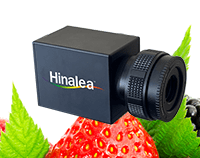
VNIR Compare
Hinalea VNIR 4200C
Spectral range = 400-1000 nm
Spectral bands = 300 nominal
Spectral resolution = 4 nm (FWHM)
Dynamic range = User selectable 8 or 16 bit
Standard lens = 3.6 to 6? Field of View (FOV) – 300 mm to ?. T-mount (M42x0.75)
Input voltage = 110 VAC at 60Hz / 220 VAC at 50Hz
Data interfaces = USB 2.0, 3.0
Operating temperature = 15? to 45? C
Humidity = 65% non-condensing
Sensor spatial resolution = 2.3 or 5 MP *
Illumination = Optional
Dimensions (L x W x H) = 85 mm x 59 mm x 70mm
Weight = 530 g
* RGGB sensor; effective monochromatic equivalent 588,544 pixels and 2.5 MP, respectively for 2.3 and 5 MP sensors without demosaicing.

Quick Comparison
| Hinalea VNIR 4200C remove | HySpex Mjolnir S-620 remove | HySpex Baldur S-384 N remove | HySpex Mjolnir V-1240 remove | HySpex VNIR-3000N remove | Resonon Pika IR-L remove | |
|---|---|---|---|---|---|---|
| Name | Hinalea VNIR 4200C remove | HySpex Mjolnir S-620 remove | HySpex Baldur S-384 N remove | HySpex Mjolnir V-1240 remove | HySpex VNIR-3000N remove | Resonon Pika IR-L remove |
| Image |  |  |  |  |  |  |
| Rating | ||||||
| Content | HinaLea?s 4200C MiniVIS hyperspectral imaging sensor covers the 400-1000 nm spectral range in a small-formfactor, highly portable, lightweight package. Based on front-staring Fabry Perot technology, 4200C includes hardware and software required to support a broad range of hyperspectral imaging applications. Key specifications include 300 spectral bands at a spectral resolution of 4 nm (FWHM). The 4200C captures a complete high-spatial-resolution image data-cube across the visible to near infrared spectral range in seconds, but can also be programmed to scan a subset of bands. The ability to dynamically control the sensor based on the application and object to be imaged optimizes data-capture and data-processing efficiency. Thanks to its design, the HinaLea 4200C offers high spectral and spatial resolution without the image uniformity challenges of line-scanning and patterned filter snapshot multi-spectral imagers present. In addition, HinaLea has developed this new sensor to be small, lightweight, and affordable for straightforward deployment in a lab setting, in a production environment, or in the field. | HySpex Mjolnir S-620 The HySpex Mjolnir S-620 hyperspectral imaging system for UAVs is the SWIR version of the Mjolnir camera series. Similar to the VNIR version, it provides a unique combination of small form factor and low mass, combined with high-performance specifications and scientific grade data quality. With a weight of less than 4.5 kg and less than 50 W power consumption, HySpex Mjolnir S-620 is very well suited for a wide range of UAVs. NEO offers high-performance unmanned aerial vehicles, fully integrated with the HySpex Mjolnir S-620. The UAV is fitted with a standard battery package allowing up to 30 minutes of flight time. All HySpex Mjolnir systems can also be mounted on a tripod and rotation stage for ground use. | HySpex Baldur S-384 N Baldur S-384 N covers the spectral range from 960-2500 nm. All Baldur cameras are Nyquist cameras giving a spectral resolution of 2 spectral bands while capturing 4 times as much light as the classic systems. To ensure that the most information per framerate is provided, the spectral resolution is kept very close to 2 bands. Additionally, the spatial resolution of Baldur S-384 N is better than 1.5 pixels, yielding a very sharp camera. | HySpex Mjolnir V-1240 The HySpex Mjolnir V-1240 hyperspectral imaging system for UAVs provides a unique combination of small form factor and low mass, combined with high-performance specifications and scientific grade data quality. With a weight of less than 4 kg and less than 50 W power consumption, HySpex Mjolnir V-1240 is very well suited for a wide range of UAVs. The system is also compatible with several off-the-shelf gimbals. NEO offers high-performance unmanned aerial vehicles, fully integrated with the HySpex Mjolnir V-1240. The UAV is fitted with a standard battery package allowing up to 30 minutes of flight time. All HySpex Mjolnir systems can also be mounted on a tripod and rotation stage for ground use. | HySpex VNIR-3000 N HySpex VNIR-3000 N is developed for field, laboratory, and airborne applications. HySpex VNIR-3000 N utilizes the same spectrograph as the other classical HySpex VNIR models. With a pixel size of 3.45?m, compared to 6. 5?m for VNIR-1800, HySpex VNIR-3000 N will have less than 1.6 pixels per FWHM of the PSF spatially and less than 1.8 bands spectrally, ensuring that narrow band features will be resolved equally for all cameras. With 3000 spatial pixels, 300 bands and a noise floor of 2.4e-, HySpex VNIR-3000N will provide outstanding SNR levels in dark environments. The camera is offered with a USB connection, allowing camera operation from any computer and reducing the cost of supplementing equipment. To visualize that the camera has a wider PSF per pixel and band relative to our normal extremely sharp cameras, we have added an N for Nyquist to the model name. | Pika IR-L 925 - 1700 nm Lightweight Infrared The Pika IR-L is a lightweight and compact Near-Infrared (925-1,700 nm) imager. The small size and mass make it well suited for airborne applications, where it can provide invisible to the naked-eye contrast of outdoor features. For a compact, lightweight Visible light spectral range option, please see the Pika L. For a higher spectral and spatial resolution version of the Pika IR-L, please see the Pika IR-L+ imager. |
| Description | Spectral range = 400-1000 nm Spectral bands = 300 nominal Spectral resolution = 4 nm (FWHM) Dynamic range = User selectable 8 or 16 bit Standard lens = 3.6 to 6? Field of View (FOV) - 300 mm to ?. T-mount (M42x0.75) Input voltage = 110 VAC at 60Hz / 220 VAC at 50Hz Data interfaces = USB 2.0, 3.0 Operating temperature = 15? to 45? C Humidity = 65% non-condensing Sensor spatial resolution = 2.3 or 5 MP * Illumination = Optional Dimensions (L x W x H) = 85 mm x 59 mm x 70mm Weight = 530 g * RGGB sensor; effective monochromatic equivalent 588,544 pixels and 2.5 MP, respectively for 2.3 and 5 MP sensors without demosaicing. | Spectral range = 970 - 2500 nm Spatial pixels = 620 Spectral channels and sampling = 300 bands @ 5.1 nm F-number = F1.9 FOV = 20? Pixel FOV across/along = 0.54/0.54 mrad Bit resolution = 16 bit Noise floor = 80 e- Dynamic range = 10000 Peak SNR (at full resolution) > 900 Max speed (at full resolution) = 170 fps Power consumption* = 50 W Dimensions (l-w-h)* = 254 - 175 - 170 mm Weight* < 4.5 kg *Includes IMU/GPS and DAU - <5 kg including standard battery | Spectral Range = 960 - 2500nm Spectral bands = 288 Max speed* = 500 fps Spectral sampling = 5.45 nm Spectral FWHM <2 bands Spatial FWHM <1.3 pixels Spatial pixels = 384 Keystone <15% of a pixel Smile <15% of band FOV = 16? / 40? Bit resolution = 16 bit Noise floor = 150 e- Peak SNR >1100 Dynamic range = 7500 ROI* = All bands can be selected/deselected individually External trigger options LVDS, 5V/12V/24V TTL Dimensions (l-w-h) = 368 - 131 - 175 mm Camera Interface = CameraLink * Reducing the number of spectral channels with ROI will proportionally increase the max framerate | Spectral range = 400 - 1000 nm Spatial pixels = 1240 Spectral channels and sampling = 200 bands @ 3 nm F-number = F1.8 FOV = 20? Pixel FOV across/along = 0.27/0.27 mrad Bit resolution = 12 bit Noise floor = 2.3 e- Dynamic range = 4400 Peak SNR (at full resolution) > 180 Max speed (at full resolution) = 285 fps Power consumption = 50 W Dimensions (l-w-h) = 250 - 175 - 170 mm Weight < 4 kg *Includes IMU/GPS and DAU - <6.5 kg including standard battery | Spectral range = 400 - 1000 nm Spatial pixels = 3000 Spectral channels = 300 Spectral sampling = 2.0 nm FOV* = 16? Pixel FOV across/along* = 0.096/0.32 mrad Bit resolution = 12 bit Noise floor = 2.37 e- Dynamic range = 11000 Peak SNR (at full resolution) > 170 Max speed (at full resolution) = 117 fps Power consumption = 30 W Dimensions (l-w-h) = 39 - 9.9- 15 cm Weight = 5.0 kg Camera Interface = USB3 *Can be doubled with FOV expander | Spectral Range (nm) = 925 - 1700 Spectral Channels = 236 Spectral Bandwidth (nm) = 3.3 Spectral Resolution - FWHM (nm) = 5.9 Spatial Pixels = 320 Max Frame Rate (fps) = 364 f/# = 1.8 Interface = GigE Dimensions (mm) = 210 x 68 x 63 Weight, w/o lens (kg) = 1.01 |


Leave a Reply