
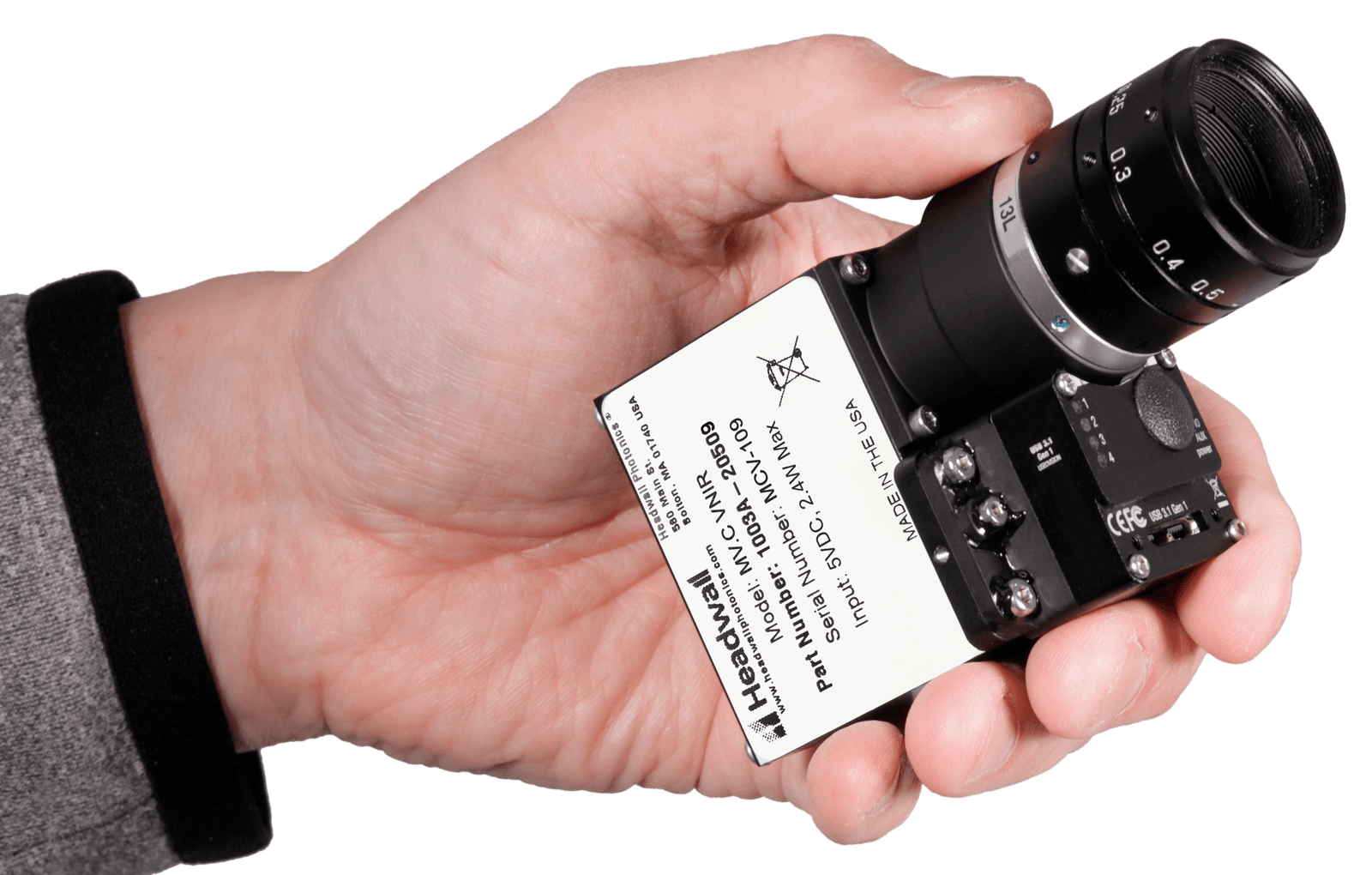
Hyperspec? MV.C VNIR
The Hyperspec? MV.C combines exceptionally small size and light weight with high spatial and spectral resolution (342 spectral bands, 1024 spatial pixels). USB 3.1 connectivity is standard, with an SDK for your OEM application.
Headwall Hyperspec MV.C VNIR
VNIR Compare
Headwall Hyperspec MV.C VNIR
Wavelength Range = 400 – 1,000 nm
Spectral Bands = 342
Spatial Pixels = 1024
Camera Technology = CMOS
Pixel Pitch = 5.86 ?m
Aperture = f/2.5
Dispersion/Pixel = 1.75 nm
Entrance Slit Width = 20 ?m
FWHM Slit Image = 6 nm
Frame Rate (Sustained)* = 400 Hz
ADC Bit Depth = 12-bits
Spectrograph Design = Aberration-Corrected Concentric
Interface USB = 3.1
Weight (without lens) = 0.3 kg / 10.6 oz
Dimensions (without lens) = 64 x 50 x 38 mm / 2.5 x 2.0 x 1.5 in
Power Input = 5 VDC
Operational Temp Range = 0 – 50 ?C / 32 – 122 ?F
*Higher frame rates attainable with certain configurations

Quick Comparison
| Headwall Hyperspec MV.C VNIR remove | HySpex VS-1200 remove | Specim FX50 remove | Resonon Pika XC2 remove | Specim Fenix remove | Resonon Pika UV remove | |
|---|---|---|---|---|---|---|
| Name | Headwall Hyperspec MV.C VNIR remove | HySpex VS-1200 remove | Specim FX50 remove | Resonon Pika XC2 remove | Specim Fenix remove | Resonon Pika UV remove |
| Image |  |  |  |  |  |  |
| Rating | ||||||
| Content | Hyperspec? MV.C VNIR The Hyperspec? MV.C combines exceptionally small size and light weight with high spatial and spectral resolution (342 spectral bands, 1024 spatial pixels). USB 3.1 connectivity is standard, with an SDK for your OEM application. | HySpex VS-1200 The HySpex VS-1200 hyperspectral camera is developed for airborne applications requiring extreme resolution in both VNIR and SWIR spectral regions. The HySpex VS-1200 is a novel high-resolution instrument designed for airborne applications at altitudes greater than 400m. The camera produces the highest scientific grade level data, commercially available, having FWHM less than 1.2 pixels spatially and less than 1.5 pixels spectrally. The combined VNIR-SWIR cube has coregistration errors, and smile and keystone of less than 10% of a pixel. With 40 degrees FOV, the camera is ideal for mapping large areas with high accuracy and resolution. The camera is delivered with an integrated high-performance IMU/GPS and data acquisition unit with removable storage bays as a standard. Existing navigation systems can also be integrated/utilized. A standard passive damping solution is included as a part of the default delivery package, but mounting plates for active damping solutions, such as GSM4000 or PAV80 can be supplied. | Specim FX50 Specim FX50 is the only hyperspectral camera on the market covering the full mid-wave infrared (MWIR) spectral range of 2.7 - 5.3 ?m required, for example, in black plastics sorting. Specim FX50 is a high-speed, accurate, and efficient line-scan hyperspectral camera designed specifically for industrial environments. | Pika XC2 400 - 1000 nm High-Precision VNIR The Pika XC2 is a high-resolution hyperspectral camera that covers the Visible + Near-Infrared (VNIR) spectral range. The Pika XC2 has high spatial resolution, best in-class spectral resolution, and excellent imaging quality. Popular in VNIR laboratory applications. The Pika XC2 can be used in our laboratory, and outdoor, and airborne hyperspectral systems, as well as standalone or integrated into your system. | Fenix FENIX is optimized for the most demanding geological, law enforcement, and environmental applications. In a single continuous image, FENIX spectral camera delivers the best hyperspectral data ever seen over VNIR, NIR, and SWIR wavelengths. FENIX offers extreme ruggedness and 75% reduction in size and weight compared to previous multi-sensor systems. The excellence in technical performance and physical size has been achieved through innovative and unique ?single optics dual spectrograph? design. | Pika UV 330 - 800 nm Ultraviolet + Visible The Pika UV (formerly NUV2) is a hyperspectral camera that scans the Visible and Near Ultraviolet (VIS+NUV) spectral range. An optimized objective lens provides excellent imaging throughout the entire spectral range. Because halogen lights have low output in much of the NUV, Resonon offers an NUV lighting module to augment illumination for our desktop system. The Pika UV can be used in our airborne, laboratory, and outdoor hyperspectral systems, as well as standalone or integrated into your system. |
| Description | Wavelength Range = 400 - 1,000 nm Spectral Bands = 342 Spatial Pixels = 1024 Camera Technology = CMOS Pixel Pitch = 5.86 ?m Aperture = f/2.5 Dispersion/Pixel = 1.75 nm Entrance Slit Width = 20 ?m FWHM Slit Image = 6 nm Frame Rate (Sustained)* = 400 Hz ADC Bit Depth = 12-bits Spectrograph Design = Aberration-Corrected Concentric Interface USB = 3.1 Weight (without lens) = 0.3 kg / 10.6 oz Dimensions (without lens) = 64 x 50 x 38 mm / 2.5 x 2.0 x 1.5 in Power Input = 5 VDC Operational Temp Range = 0 - 50 ?C / 32 - 122 ?F *Higher frame rates attainable with certain configurations | Spectral Range = 2.7 - 5.3 ?m Spectral resolution (FWHM) = 35 nm Spectral sampling/pixel = 8.44 nm, Without binning Spectral bands = 154, With default binning Numerical aperture = 2.0 Optics magnification = 0.5 Effective pixel size = 30 ?m, At fore lens image plane Effective slit width = 104 ?m, At fore lens image plane Effective slit length = 19.2 mm, At fore lens image plane Dynamic Range = 1600:1 with 1.5 ms exposure time Usable dynamic range / noise Spatial samples = 640 Bit depth = 16 Maximum frame rate = 380 fps, Full image with default binning Binning = 1,2,4 spectral and spatial, Default: 2 spectral x 1 spatial ROI = Freely selectable multiple bands of interest. Minimum height of ROI is two 1-binned rows. Maximum frame rate is determined by total number of rows between first row of first mROI and last row of last mROI - not the total number of rows included in the mMROI?s. Pixel operability = Number of operable pixels >99.7%. Allowed clusters: Size 4-8 pixels: <= 12/ Size 9-12 pixels: 2/ Size 13-19 pixels: 1/ Size >19 pixels: 0 Image corrections = Non uniformity correction/Bad pixel replacement/Automatic Image Enhancement (AIE). One point NUC. AIE: Unified spectral calibration + corrected smile and keystone aberrations Sensor material = InSb Integrated cooler = Stirling Up to 10000 hours Full well capacity = 5.1 Me- Read-out modes = IWR / ITR Optics temperature = TEC-stabilized Default is 20 degrees Celsius Lens mount = Custom mount Fore lens options = OLEM43, OLEM23, OLEM17 Field of view = 24 deg, 45 deg, 60 deg Camera digital data output/control interface = GigE Vision, Custom ethernet Camera control protocols = GenICam, JSON-RPC Power input = 24 V DC Power consumption = Max 90 W, Typical 40 W, During simultaneous cool-down of optics and detector Connectors = Ethernet/ Aux - 0306423 (09-0428-90-08) Binder 8pin/ Power - 0306627 (LF10WBR-4P) Hirose 4pin Trigger in IP = IP40 Dimensions (L x W x H) = 280 x 202 x 169 mm Mounting surface option on three sides. Mounting kit adds 24 mm distance on mounting side. Weight = 7 kg Storage temperature = -20 ... +50 oC Operating temperature = +5 ... +40 oC Relative humidity = 5% - 95% (non-condensing) | Spectral Range (nm) = 400 - 1000 Spectral Channels = 447 Spectral Bandwidth (nm) = 1.3 Spectral Resolution - FWHM (nm) = 1.9 Spatial Pixels = 1600 Max Frame Rate (fps) = 165 f/# = 2.4 Interface = USB 3.0 Dimensions (mm) = 265 x 106 x 75 Weight, w/o lens (kg) = 2.51 | Spectral Range (nm) = 330 - 800 Spectral Channels = 255 Spectral Bandwidth (nm) = 1.8 Spectral Resolution - FWHM (nm) = 2.8 Spatial Pixels = 1500 Max Frame Rate (fps) = 142 f/# = 2.8 InterfaceUSB = 3.0 Dimensions (mm) = 230 x 107 x 85 Weight, w/o lens (kg) = 2.27 |


Leave a Reply