
World?s lightest HSI camera
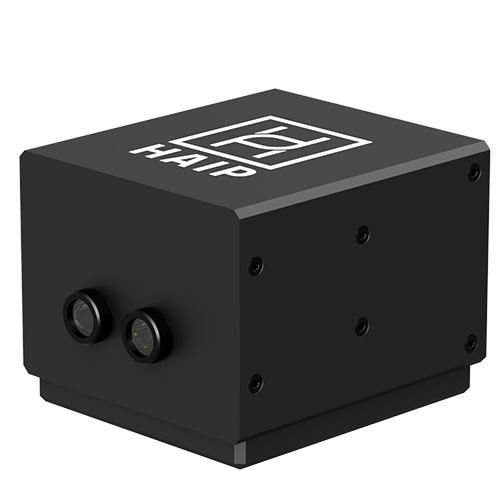
BlackBullet V2 is based on a hyperspectral linescanner, but there is no need to move the sensor during image acquisition to get a full hyperspectral data cube. With this feature your use case can benefit from a compact and lightweight measuring setup. The BlackBullet V2 camera was especially designed for UAV implementation with its lightweight design, but of course there is a multitude of other applications. A mounting plate with different type of threads is delivered with the camera to mount it whereever needed. Camera control works via Gigabit Ethernet, which opens up to a wide range of mounting options.
The desired spectral ranges can be individually selected. Additional pre-processing on camera is possible, as the camera has a build in NVIDIA Jetson GPU. BlackBullet is optimised for combined use with seperate available broadband LED lighting unit BlackBright
Haip BlackBullet V2
VNIR Compare
Haip BlackBullet V2
Wavelength range = 500-1000 nm
Number of bands = 250
Spectral resolution = 5 nm
Spectral sampling = 2 nm
Resolution RGB = 2688 * 1512 px
Resolution Spectral = 540 x 540 px
Field of View – HSI/RGB = 33?/37?
Detector = CMOS
Sensor size = 2 Megapixel
Radiometric resolution = 10 bit
Integration time (cube) < 3 seconds
Data size (raw) = 100 MB/ Data cube
Connection = GigE
Operation temperature = -10 - +50?C
Protection class = IP 40
Power consumption = 100-240 V DC / 15 W
Size =80 x 60 x 90 mm
Weight = 630 g

Quick Comparison
| Haip BlackBullet V2 remove | HySpex Mjolnir S-620 remove | Specim FX50 remove | Specim FX10+ remove | HySpex VS-1200 remove | HySpex VNIR-3000N remove | |
|---|---|---|---|---|---|---|
| Name | Haip BlackBullet V2 remove | HySpex Mjolnir S-620 remove | Specim FX50 remove | Specim FX10+ remove | HySpex VS-1200 remove | HySpex VNIR-3000N remove |
| Image |  |  |  |  |  |  |
| Rating | ||||||
| Content | World?s lightest HSI camera BlackBullet V2 is based on a hyperspectral linescanner, but there is no need to move the sensor during image acquisition to get a full hyperspectral data cube. With this feature your use case can benefit from a compact and lightweight measuring setup. The BlackBullet V2 camera was especially designed for UAV implementation with its lightweight design, but of course there is a multitude of other applications. A mounting plate with different type of threads is delivered with the camera to mount it whereever needed. Camera control works via Gigabit Ethernet, which opens up to a wide range of mounting options. The desired spectral ranges can be individually selected. Additional pre-processing on camera is possible, as the camera has a build in NVIDIA Jetson GPU. BlackBullet is optimised for combined use with seperate available broadband LED lighting unit BlackBright | HySpex Mjolnir S-620 The HySpex Mjolnir S-620 hyperspectral imaging system for UAVs is the SWIR version of the Mjolnir camera series. Similar to the VNIR version, it provides a unique combination of small form factor and low mass, combined with high-performance specifications and scientific grade data quality. With a weight of less than 4.5 kg and less than 50 W power consumption, HySpex Mjolnir S-620 is very well suited for a wide range of UAVs. NEO offers high-performance unmanned aerial vehicles, fully integrated with the HySpex Mjolnir S-620. The UAV is fitted with a standard battery package allowing up to 30 minutes of flight time. All HySpex Mjolnir systems can also be mounted on a tripod and rotation stage for ground use. | Specim FX50 Specim FX50 is the only hyperspectral camera on the market covering the full mid-wave infrared (MWIR) spectral range of 2.7 - 5.3 ?m required, for example, in black plastics sorting. Specim FX50 is a high-speed, accurate, and efficient line-scan hyperspectral camera designed specifically for industrial environments. | Specim FX10+ The Specim FX10+ is a high-speed line-scan hyperspectral camera optimized for applications requiring fast imaging. Its high resolution ensures accurate and detailed imaging at a rapid pace. Specim FX10+ operates in the visible and near-infrared (VNIR) region from 400 to 1000 nm. | HySpex VS-1200 The HySpex VS-1200 hyperspectral camera is developed for airborne applications requiring extreme resolution in both VNIR and SWIR spectral regions. The HySpex VS-1200 is a novel high-resolution instrument designed for airborne applications at altitudes greater than 400m. The camera produces the highest scientific grade level data, commercially available, having FWHM less than 1.2 pixels spatially and less than 1.5 pixels spectrally. The combined VNIR-SWIR cube has coregistration errors, and smile and keystone of less than 10% of a pixel. With 40 degrees FOV, the camera is ideal for mapping large areas with high accuracy and resolution. The camera is delivered with an integrated high-performance IMU/GPS and data acquisition unit with removable storage bays as a standard. Existing navigation systems can also be integrated/utilized. A standard passive damping solution is included as a part of the default delivery package, but mounting plates for active damping solutions, such as GSM4000 or PAV80 can be supplied. | HySpex VNIR-3000 N HySpex VNIR-3000 N is developed for field, laboratory, and airborne applications. HySpex VNIR-3000 N utilizes the same spectrograph as the other classical HySpex VNIR models. With a pixel size of 3.45?m, compared to 6. 5?m for VNIR-1800, HySpex VNIR-3000 N will have less than 1.6 pixels per FWHM of the PSF spatially and less than 1.8 bands spectrally, ensuring that narrow band features will be resolved equally for all cameras. With 3000 spatial pixels, 300 bands and a noise floor of 2.4e-, HySpex VNIR-3000N will provide outstanding SNR levels in dark environments. The camera is offered with a USB connection, allowing camera operation from any computer and reducing the cost of supplementing equipment. To visualize that the camera has a wider PSF per pixel and band relative to our normal extremely sharp cameras, we have added an N for Nyquist to the model name. |
| Description | Wavelength range = 500-1000 nm Number of bands = 250 Spectral resolution = 5 nm Spectral sampling = 2 nm Resolution RGB = 2688 * 1512 px Resolution Spectral = 540 x 540 px Field of View - HSI/RGB = 33?/37? Detector = CMOS Sensor size = 2 Megapixel Radiometric resolution = 10 bit Integration time (cube) < 3 seconds Data size (raw) = 100 MB/ Data cube Connection = GigE Operation temperature = -10 - +50?C Protection class = IP 40 Power consumption = 100-240 V DC / 15 W Size =80 x 60 x 90 mm Weight = 630 g | Spectral range = 970 - 2500 nm Spatial pixels = 620 Spectral channels and sampling = 300 bands @ 5.1 nm F-number = F1.9 FOV = 20? Pixel FOV across/along = 0.54/0.54 mrad Bit resolution = 16 bit Noise floor = 80 e- Dynamic range = 10000 Peak SNR (at full resolution) > 900 Max speed (at full resolution) = 170 fps Power consumption* = 50 W Dimensions (l-w-h)* = 254 - 175 - 170 mm Weight* < 4.5 kg *Includes IMU/GPS and DAU - <5 kg including standard battery | Spectral Range = 2.7 - 5.3 ?m Spectral resolution (FWHM) = 35 nm Spectral sampling/pixel = 8.44 nm, Without binning Spectral bands = 154, With default binning Numerical aperture = 2.0 Optics magnification = 0.5 Effective pixel size = 30 ?m, At fore lens image plane Effective slit width = 104 ?m, At fore lens image plane Effective slit length = 19.2 mm, At fore lens image plane Dynamic Range = 1600:1 with 1.5 ms exposure time Usable dynamic range / noise Spatial samples = 640 Bit depth = 16 Maximum frame rate = 380 fps, Full image with default binning Binning = 1,2,4 spectral and spatial, Default: 2 spectral x 1 spatial ROI = Freely selectable multiple bands of interest. Minimum height of ROI is two 1-binned rows. Maximum frame rate is determined by total number of rows between first row of first mROI and last row of last mROI - not the total number of rows included in the mMROI?s. Pixel operability = Number of operable pixels >99.7%. Allowed clusters: Size 4-8 pixels: <= 12/ Size 9-12 pixels: 2/ Size 13-19 pixels: 1/ Size >19 pixels: 0 Image corrections = Non uniformity correction/Bad pixel replacement/Automatic Image Enhancement (AIE). One point NUC. AIE: Unified spectral calibration + corrected smile and keystone aberrations Sensor material = InSb Integrated cooler = Stirling Up to 10000 hours Full well capacity = 5.1 Me- Read-out modes = IWR / ITR Optics temperature = TEC-stabilized Default is 20 degrees Celsius Lens mount = Custom mount Fore lens options = OLEM43, OLEM23, OLEM17 Field of view = 24 deg, 45 deg, 60 deg Camera digital data output/control interface = GigE Vision, Custom ethernet Camera control protocols = GenICam, JSON-RPC Power input = 24 V DC Power consumption = Max 90 W, Typical 40 W, During simultaneous cool-down of optics and detector Connectors = Ethernet/ Aux - 0306423 (09-0428-90-08) Binder 8pin/ Power - 0306627 (LF10WBR-4P) Hirose 4pin Trigger in IP = IP40 Dimensions (L x W x H) = 280 x 202 x 169 mm Mounting surface option on three sides. Mounting kit adds 24 mm distance on mounting side. Weight = 7 kg Storage temperature = -20 ... +50 oC Operating temperature = +5 ... +40 oC Relative humidity = 5% - 95% (non-condensing) | Spectral Range = 400-1000 nm Spectral resolution (FWHM) = 15 nm, Typical mean Spectral sampling/pixel = 6.3 nm, With default binning Spectral bands = 100, With default binning Numerical aperture = 1.7, With default lens Optics magnification = 0.80 Effective pixel size = 19.9x9.97 ?m, At fore lens image plane Effective slit width = 42 ?m, At fore lens image plane Effective slit length = 10.2 mm, At fore lens image plane SNR @ max. signal = 420 : 1 Spatial samples = 1024 Bit depth = 12 Maximum frame rate = 705 FPS full range. With 2-spectral binning (Bands: Max FPS) = 1:9900/5:6500/20:2800/35:1813/70:985 Binning = 2,4,8 spectral and spatial, Default: 2 spectral x 1 spatial ROI = Freely selectable multiple bands of interest, Minimum height of ROI is two 1-binned rows. Maximum frame rate is determined by the total number of rows included in the mMROI?s Pixel operability = 99.993% Image corrections = Non uniformity correction/Bad pixel replacement/Automatic Image Enhancement (AIE). AIE: Unified spectral calibration + corrected smile and keystone aberrations. One point NUC Sensor material = CMOS Sensor cooling = Passive Full well capacity = 90 ke- Read-out modes = IWR / ITR Optics temperature = Passive Lens mount = Custom mount Fore lens FOV options:12 deg/38 deg (default)/47 deg/51 deg/83 deg. Only the default lens is specifically designed for FX10. With other lens options, optical parameters may vary. Camera digital data output/control interface = GigE Vision Camera control protocols = GenICam, ASCII Power input = 12 V DC (+-10%) Power consumption = Max 4 W Connectors = Industrial Ethernet IP = IP52 Dimensions (L x W x H) 150 x 85 x 71 mm Mounting surface option on three sides. Mounting kit adds 24 mm distance on mounting side. Weight 1.3 kg Storage temperature = -20 ... +50?C (non-condensing) Operating temperature = +5 ? +40?C (non-condensing) Relative humidity = 5% - 95% (non-condensing) | Spectral range = 400 - 1000 nm Spatial pixels = 3000 Spectral channels = 300 Spectral sampling = 2.0 nm FOV* = 16? Pixel FOV across/along* = 0.096/0.32 mrad Bit resolution = 12 bit Noise floor = 2.37 e- Dynamic range = 11000 Peak SNR (at full resolution) > 170 Max speed (at full resolution) = 117 fps Power consumption = 30 W Dimensions (l-w-h) = 39 - 9.9- 15 cm Weight = 5.0 kg Camera Interface = USB3 *Can be doubled with FOV expander |


Leave a Reply