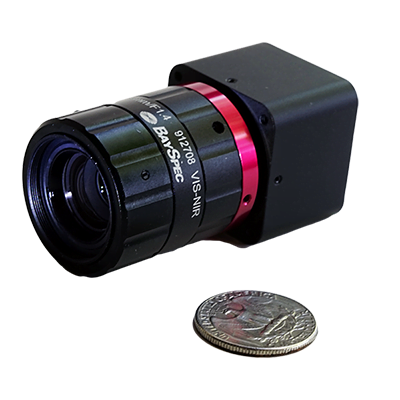
| Content | OCI?-1000 series VIS-NIR hyperspectral imaging cameras are extremely compact, light, and rugged. They cover visible - near-infrared (VIS - NIR) spectral range from 470 - 1000 nm. Unlike conventional hyperspectral imagers which rely on intensive software effort on hyperspectral image cube construction, the innovative design of the OCI?-1000 series imagers feature true push broom and ultrafast data transfer rates, with automatic data capturing and processing, they can move to scan at random speeds. The elegant completely integrated design and manufacturing in our quality certified production facility with master quality control to deliver high precision, superb signal-to-noise, excellent spectral & spatial resolution, and outstanding imaging quality. With the free packed operation software, OCI? - 1000 series hyperspectral cameras are automatic and minimum human intervention. They are ideally catered to various unmanned aerial vehicles/systems (UAV/UAS) and remotely operated vehicles (ROV). BaySpec also provides ready-to-fly hyperspectral solutions. Extreme compactness with uncompromised performance, automatic operation and data processing makes the OCI-UAV a straightforward system for board fields applications such as precision agriculture, geological survey, oceanography, remote sensing, security/defense, and anti-counterfeiting. | HySpex VNIR-3000 N
HySpex VNIR-3000 N is developed for field, laboratory, and airborne applications.
HySpex VNIR-3000 N utilizes the same spectrograph as the other classical HySpex VNIR models. With a pixel size of 3.45?m, compared to 6. 5?m for VNIR-1800, HySpex VNIR-3000 N will have less than 1.6 pixels per FWHM of the PSF spatially and less than 1.8 bands spectrally, ensuring that narrow band features will be resolved equally for all cameras. With 3000 spatial pixels, 300 bands and a noise floor of 2.4e-, HySpex VNIR-3000N will provide outstanding SNR levels in dark environments.
The camera is offered with a USB connection, allowing camera operation from any computer and reducing the cost of supplementing equipment. To visualize that the camera has a wider PSF per pixel and band relative to our normal extremely sharp cameras, we have added an N for Nyquist to the model name. | HySpex VNIR-1800
The HySpex VNIR-1800 hyperspectral camera is developed for field, laboratory, and airborne applications.
HySpex VNIR-1800 utilizes a cutting edge actively cooled and stabilized scientific CMOS detector. This makes VNIR-1800 the ideal camera for high-end data acquisitions where high radiometric accuracy is required. The dynamic range of 20 000 ensures outstanding SNR levels even in darker areas of an image of highly dynamic scenes. With a max frame rate of 260 fps, combined with aberration-corrected optics and high optical throughput (f/2.5), HySpex VNIR-1800 offers a unique combination of
data quality, high speed, and sensitivity. A wide range of close-up lenses allows the use of the camera at working distances ranging from a few centimeters with a spatial resolution of 24 ?m to infinity e.g. airborne remote sensing. | HySpex Mjolnir VS-620
For applications requiring low mass, combined with high-performance specifications and scientific grade data quality on the full VNIR-SWIR range, HySpex Mjolnir VS-620 is an ideal solution. Sharing the onboard data acquisition unit and navigation system, HySpex Mjolnir VS-620 is both space-efficient and cost-effective.
The VNIR and SWIR optical axis are coaligned in the along-track direction, assuring perfect coregistration in the flight direction. In addition to the high-quality hyperspectral data cube, covering the spectral range from 400 - 2500 nm, with 490 bands, double resolution data in the VNIR range is always readily available. With smile and keystone less than 0.1 pixels for each spectral range, the merged Mjolnir VS-620 data product will have coregistration/keystone better than 0.2 pixels for the full VNIR-SWIR range. | Specim FX10+
The Specim FX10+ is a high-speed line-scan hyperspectral camera optimized for applications requiring fast imaging. Its high resolution ensures accurate and detailed imaging at a rapid pace. Specim FX10+ operates in the visible and near-infrared (VNIR) region from 400 to 1000 nm. | HySpex Baldur S-384 N
Baldur S-384 N covers the spectral range from 960-2500 nm.
All Baldur cameras are Nyquist cameras giving a spectral resolution of 2 spectral bands while capturing 4 times as much light as the classic systems. To ensure that the most information per framerate is provided, the spectral resolution is kept very close to 2 bands. Additionally, the spatial resolution of Baldur S-384 N is better than 1.5 pixels, yielding a very sharp camera. |
| Description | Spectral Range = 600 - 1000 nm
Spectral Resolution = 5 nm FWHM
Number of Spectral Bands = 100
Frame Rate = 120 frames/sec
Dimension = 3 x 3 x 3 cm3
Weight = 45.3 g | Spectral range = 400 - 1000 nm
Spatial pixels = 3000
Spectral channels = 300
Spectral sampling = 2.0 nm
FOV* = 16?
Pixel FOV across/along* = 0.096/0.32 mrad
Bit resolution = 12 bit
Noise floor = 2.37 e-
Dynamic range = 11000
Peak SNR (at full resolution) > 170
Max speed (at full resolution) = 117 fps
Power consumption = 30 W
Dimensions (l-w-h) = 39 - 9.9- 15 cm
Weight = 5.0 kg
Camera Interface = USB3
*Can be doubled with FOV expander | Spectral range = 400 - 1000 nm
Spatial pixels = 1800
Spectral channels = 186
Spectral sampling = 3.26 nm
FOV* = 17?
Pixel FOV across/along* = 0.16/0.32 mrad
Bit resolution = 16 bit
Noise floor = 2.4 e-
Dynamic range = 20000
Peak SNR (at full resolution) > 255
Max speed (at full resolution) = 260 fps
Power consumption = 30 W
Dimensions (l-w-h) = 39 - 9.9 - 15 cm
Weight = 5.0 kg
Camera Interface = CameraLink
*Can be doubled with FOV expander | | Spectral Range = 400-1000 nm
Spectral resolution (FWHM) = 15 nm, Typical mean
Spectral sampling/pixel = 6.3 nm, With default binning
Spectral bands = 100, With default binning
Numerical aperture = 1.7, With default lens
Optics magnification = 0.80
Effective pixel size = 19.9x9.97 ?m, At fore lens image plane
Effective slit width = 42 ?m, At fore lens image plane
Effective slit length = 10.2 mm, At fore lens image plane
SNR @ max. signal = 420 : 1
Spatial samples = 1024
Bit depth = 12
Maximum frame rate = 705 FPS full range. With 2-spectral binning (Bands: Max FPS) = 1:9900/5:6500/20:2800/35:1813/70:985
Binning = 2,4,8 spectral and spatial, Default: 2 spectral x 1 spatial
ROI = Freely selectable multiple bands of interest, Minimum height of ROI is two 1-binned rows. Maximum frame rate is determined by the total number of rows included in the mMROI?s
Pixel operability = 99.993%
Image corrections = Non uniformity correction/Bad pixel replacement/Automatic Image Enhancement (AIE). AIE: Unified spectral calibration + corrected smile and keystone aberrations. One point NUC
Sensor material = CMOS
Sensor cooling = Passive
Full well capacity = 90 ke-
Read-out modes = IWR / ITR
Optics temperature = Passive
Lens mount = Custom mount
Fore lens FOV options:12 deg/38 deg (default)/47 deg/51 deg/83 deg. Only the default lens is specifically designed for FX10. With other lens options, optical parameters may vary.
Camera digital data output/control interface = GigE Vision
Camera control protocols = GenICam, ASCII
Power input = 12 V DC (+-10%)
Power consumption = Max 4 W
Connectors = Industrial Ethernet
IP = IP52
Dimensions (L x W x H) 150 x 85 x 71 mm Mounting surface option on three sides.
Mounting kit adds 24 mm distance on mounting side.
Weight 1.3 kg
Storage temperature = -20 ... +50?C (non-condensing)
Operating temperature = +5 ? +40?C (non-condensing)
Relative humidity = 5% - 95% (non-condensing) | Spectral Range = 960 - 2500nm
Spectral bands = 288
Max speed* = 500 fps
Spectral sampling = 5.45 nm
Spectral FWHM <2 bands
Spatial FWHM <1.3 pixels
Spatial pixels = 384
Keystone <15% of a pixel
Smile <15% of band
FOV = 16? / 40?
Bit resolution = 16 bit
Noise floor = 150 e-
Peak SNR >1100
Dynamic range = 7500
ROI* = All bands can be selected/deselected individually
External trigger options LVDS, 5V/12V/24V TTL
Dimensions (l-w-h) = 368 - 131 - 175 mm
Camera Interface = CameraLink
* Reducing the number of spectral channels with ROI will proportionally increase the max framerate |



Leave a Reply